Types of earring backs and clasps: choosing a comfortable fit
Compare posts, screw backs, levers and hoop catches. Learn which views to request, what to measure and how to check fit with a headset or high collar.
Maison Miréa editorial team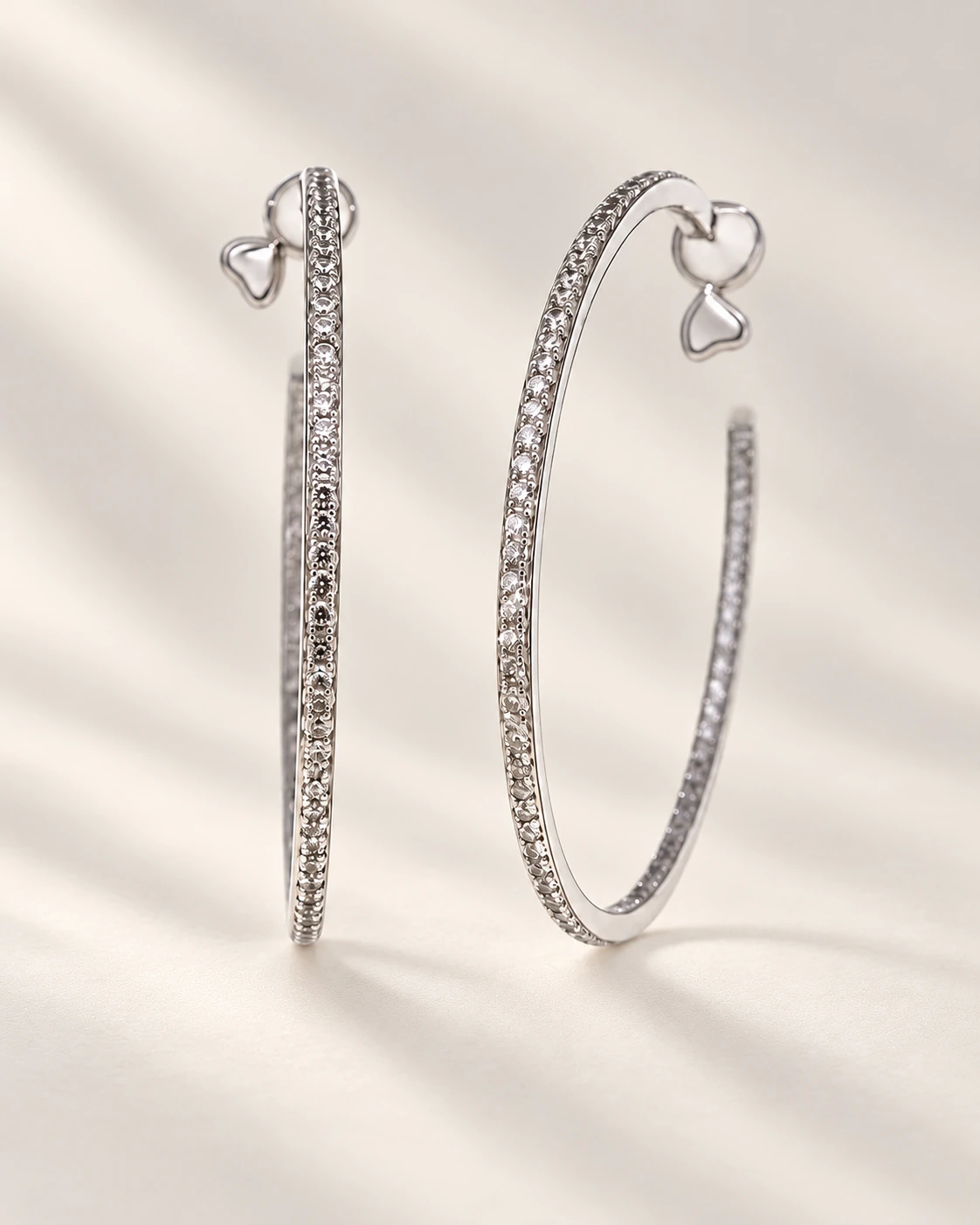
Choose an earring fastener around how you wear the pair. If you often lose separate backs, look for a hinged clasp that stays attached. If you wear over-ear headphones, check how far the post projects behind the lobe. For a higher piercing, compare the distance from the piercing to the edge of the lobe with the internal height of the closed earring.
How to recognise four fasteners
| Mechanism | How it closes | Check | Example |
|---|---|---|---|
| Post with friction back | Back slides onto post | Usable length and grip area | A confirmed push back slides straight onto the post. |
| Screw back | Turns along a thread | Room to hold and turn it | Apart guide, external reference |
| Hinged lever | Swings towards post or wire | Lobe clearance and alignment | Apart guide, external reference |
| Hinged hoop segment | Segment tip enters a receiving part | Open view and usable inside dimensions | Compare the hoop open and closed. When closed, the hinged segment enters its socket. |
Before ordering, request four views of the same model: open, closed, in profile on the ear and behind the lobe. Use the first two to trace the movement and the last two to judge clearance. “Hoop”, “stud” and “drop” describe the appearance without necessarily identifying the mechanism. The weight of a pair cannot tell you whether a post tip extends behind its back or whether you can grasp the back easily.
Post and removable back: which part comes off?
With a post earring, the post passes through the piercing and a separate back holds it behind the lobe. One common friction back has two curled wings and slides along the post. Support the earring front, line the opening up with the post and slide the back into a comfortable holding position. Avoid squeezing the lobe between the parts. A threaded back works differently: turn it along the thread instead of pushing it on like a friction back.
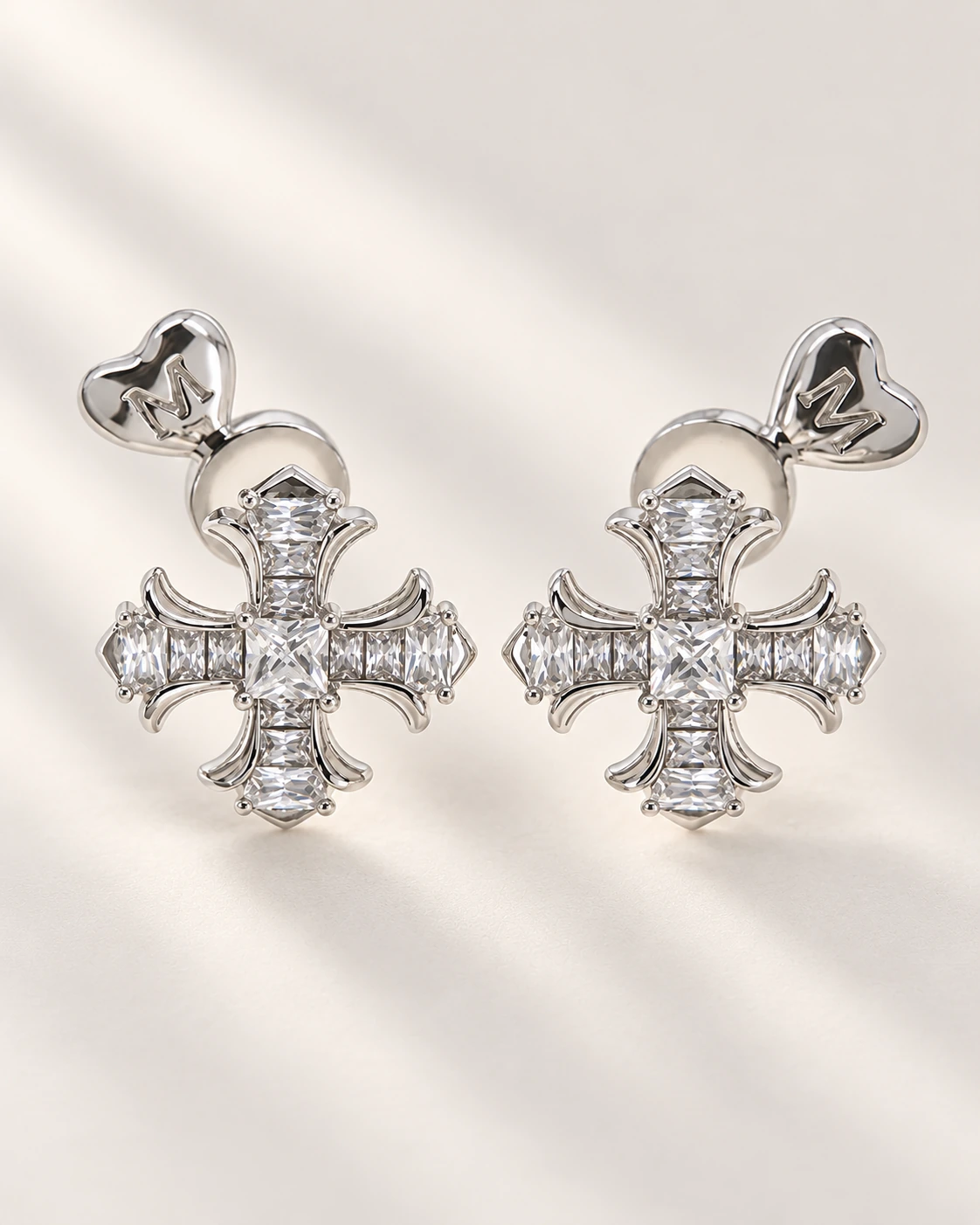
For Jardin Croix Petite, Miréa specifies studs with silver posts, a brass base and clear cubic zirconia. This identifies the component that passes through the piercing. Confirm the supplied back separately: the post material tells you nothing about its shape. Request a photograph of the back beside the earring with its opening facing the camera, followed by a view with the two assembled. You can then judge the part you will handle and how much room it takes behind the ear.
A hinged lever behind the lobe
With a hinged lever, the front and back stay together. Find the hinge at the bottom, then follow the free end to where it meets the front when closed. On a hinged post catch, the rear arm meets a post. On a leverback ear wire, it can meet the tip of a curved wire. Retail terminology varies, especially in translation. The official Apart guide to earring fastenings illustrates different constructions. These are third-party references for identification.
Hold the body near the hinge when opening so the stone or drop does not take the load. Open only as far as the mechanism is designed to travel. Once it is on, check that the tip has entered its intended seat and is not resting against the side. A click alone is not proof of alignment. Check the internal height between the post and lower curve. That space must accommodate the distance from the piercing to the bottom of your lobe.
Hoops: locate the opening
Look at the top of the hoop. On one design, a fine hinged segment swings out and its tip enters a socket at the other end of the curve. On another, a crossbar drops into a separate catch. Some hoops use a straight post and removable back. They can look alike when closed. On the open photograph, locate the pivot, free end and receiving piece. Avoid spreading a thick hoop sideways to guess where it opens.
Courbe Orbite has a large, fine outline with clear accents. In Miréa’s hand-held footage the curve is visible, but the fingers cover the top. That frame cannot identify the clasp. Ask to see the hoop open on a table, with the top clear of fingers. This is more informative than another front view: you can see whether a component comes off and how wide the entrance opens for the lobe.
Which measurements matter for fit
For a post, ask for the usable distance between the underside of the front and the face of the back in its holding position. Overall post length answers a different question. For a hinge, request the internal depth where the lobe will sit. With a hoop, add the height below the post. External diameter includes the metal and fastening. Mark the measuring points on a picture so that you and the seller are discussing the same dimension.
Photograph a pair you already find comfortable, closed and in profile beside a millimetre scale. Avoid compressing the lobe with a tool to measure it. The familiar earring makes a more practical reference. A higher piercing changes where the lower curve falls, while lobe thickness affects the available post length. Compare each ear separately if the same pair sits differently on the left and right.
Four everyday handling checks
Try putting on one earring in front of the mirror you normally use in the morning. Place a soft cloth on the counter to catch a loose back and open the fastening before bringing it to the ear. Can one hand support the front while the other locates the back without seeing behind the lobe? Repeat on the other side. A mechanism you can handle at a table may call for a different hand position at your bathroom mirror.
With long nails, pay attention to the area available to grip. Can you hold the back with your fingertips without putting a nail between the wings? For a lever, see whether there is room to press the intended part without leaning on a stone. Size alone may not predict ease of use. The projection you can grasp and the direction of opening matter too. If you feel tempted to prise it open with a sharp object, ask for a demonstration or try another mechanism.
Put on the headset you use for calls and adjust it as usual. Turn slightly, lift the ear cup and put it back. Does it touch the earring face, the tip behind the ear or the lower curve of a hoop? Check the back again after removing the headset. Try another construction if pressure keeps returning. A lighter front will not remove a projecting tip that catches the edge of the cup.
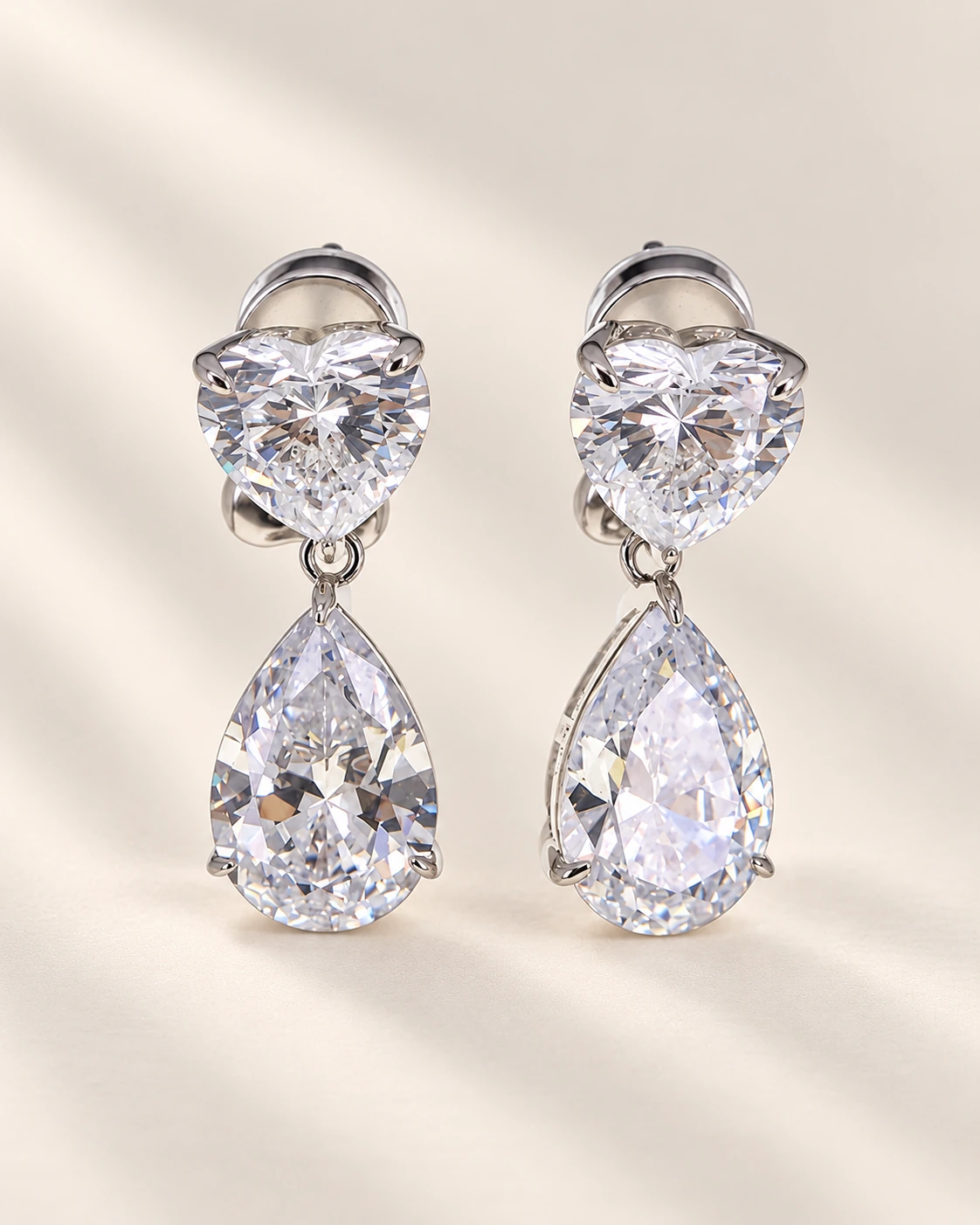
With a high collar, compare the collar down and fully fastened. On Lumière Larme, a pear-shaped drop sits below a rounded upper stone. As you turn, follow the drop to see whether it meets the fabric, then inspect the back behind the piercing separately. A collar nudging the drop feels different from pressure at the clasp. To assess this model’s fastening, ask for open and closed views rather than using the pear shape to identify the mechanism.
Check the closure before leaving the mirror
Start with the mechanism in your hands over a table. Notice the position of each component when fully closed. Support the body, open it normally and note the direction in which the parts separate. Put it on and use a small mirror to compare the position behind your ear with that reference. A visual check and light touch are enough. Avoid pulling on the stone or bending the post if it misses its seat.
If you own a spare back, do not assume it is suitable simply because it slides onto another post. The size of the opening, retention mechanism and condition of the clutch matter. Ask for a compatible replacement for the exact model. Store backs together as pairs in separate compartments to avoid mixing similar fittings. If one back becomes noticeably looser than its partner, leave that earring off until the seller or a jeweller checks it.
For a gift, ask about the movement the recipient is used to as well as the shape they like. Someone who prefers holding a single item may favour an attached back. Another person may like a removable component they can set down while placing the front. Ask to see a familiar pair from behind. It is a better reference than the phrase “comfortable fastening” and does not require guessing from a portrait.