Pendant with or without a chain? What to check before buying
Check what comes with a pendant, measure its bail and the end of your chain, and see where the pendant will fall against a favourite neckline.
Maison Miréa editorial team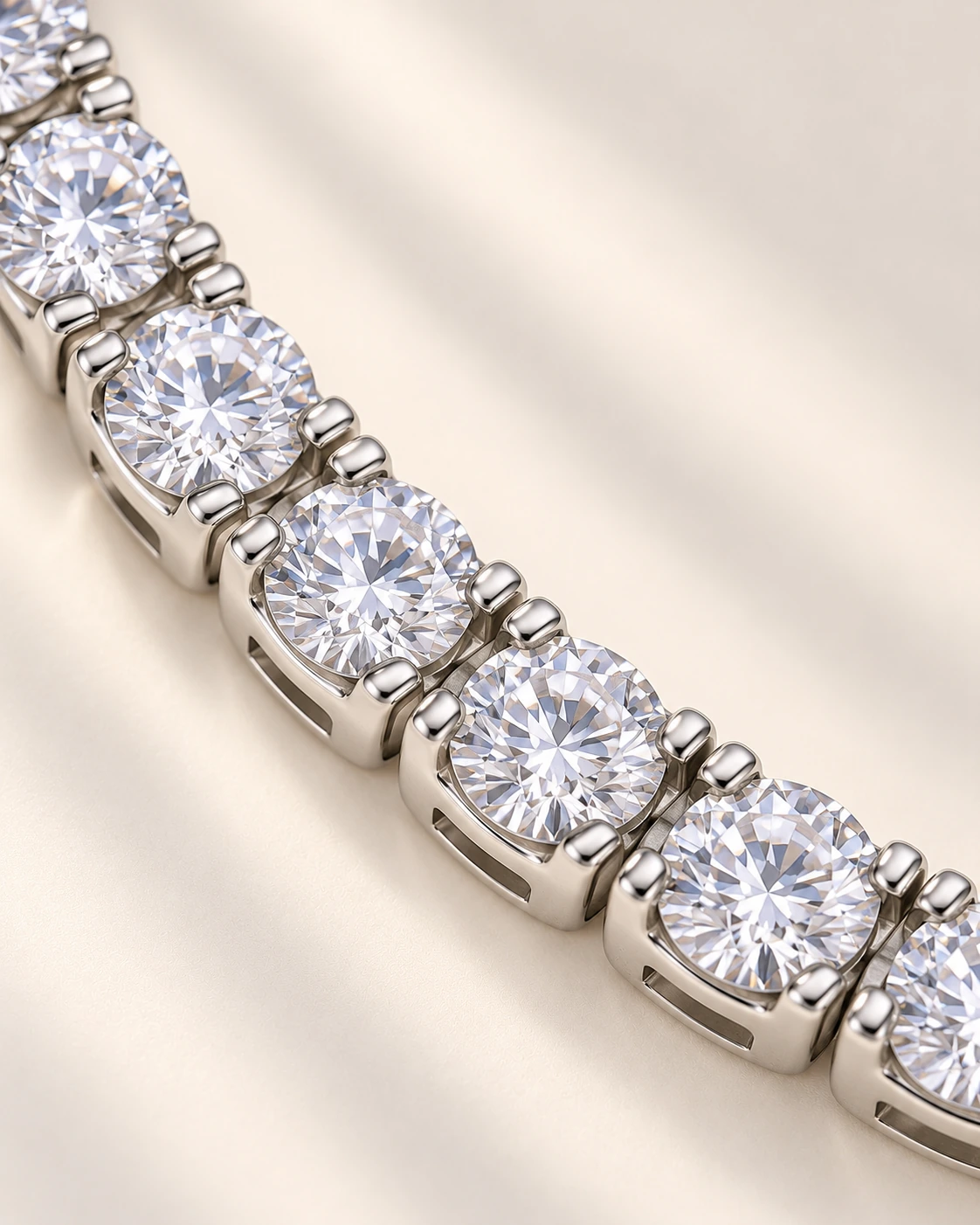
For a complete necklace, check what is included and the wearable length. For a separate pendant, inspect the largest fitting on the end you intend to thread. The entire tip, including its rings, has to pass freely through the bail. Link width alone cannot establish that. Once threaded, hold up both ends of the chain and see whether the pendant settles face forward.
What the listing tells you
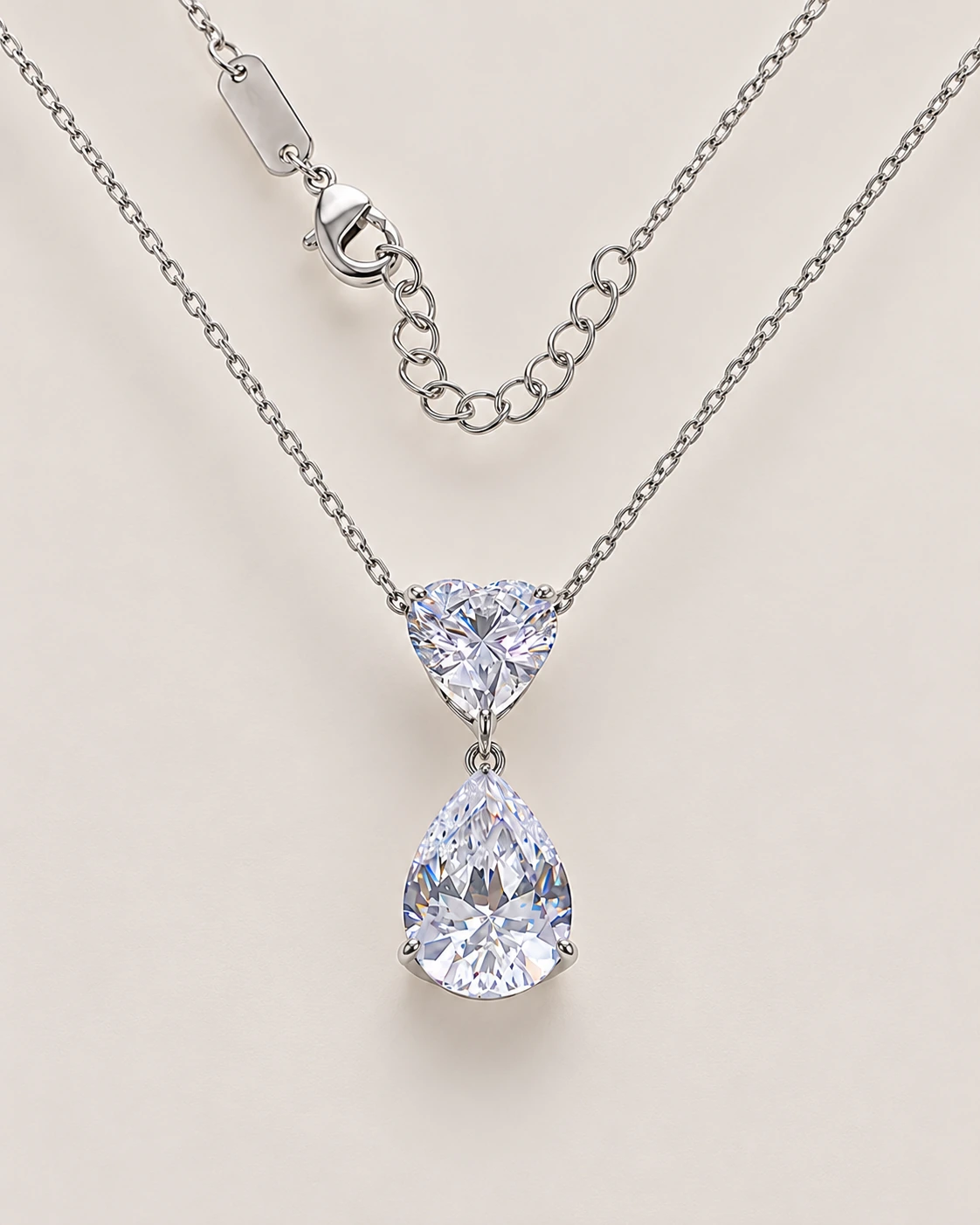
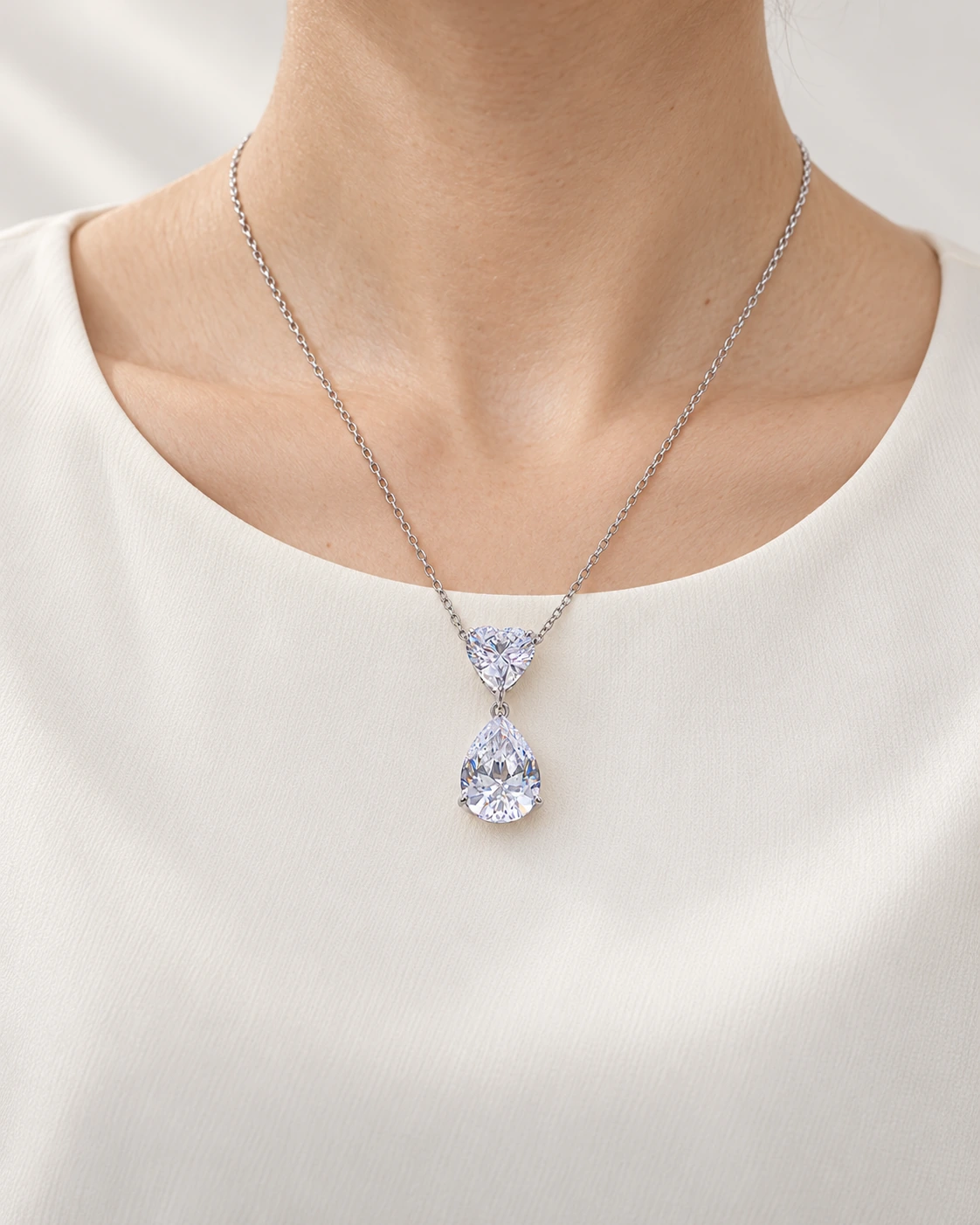
Miréa lists Lumière Larme as a complete necklace. A clear drop hangs beneath a small rounded detail, and the chain measures 42 cm with a 3 cm extender. This answers the question for someone who wants a piece to put on straight away. The listing does not confirm that the drop can be transferred. If you specifically want it for a family chain, ask about removal before placing the order.
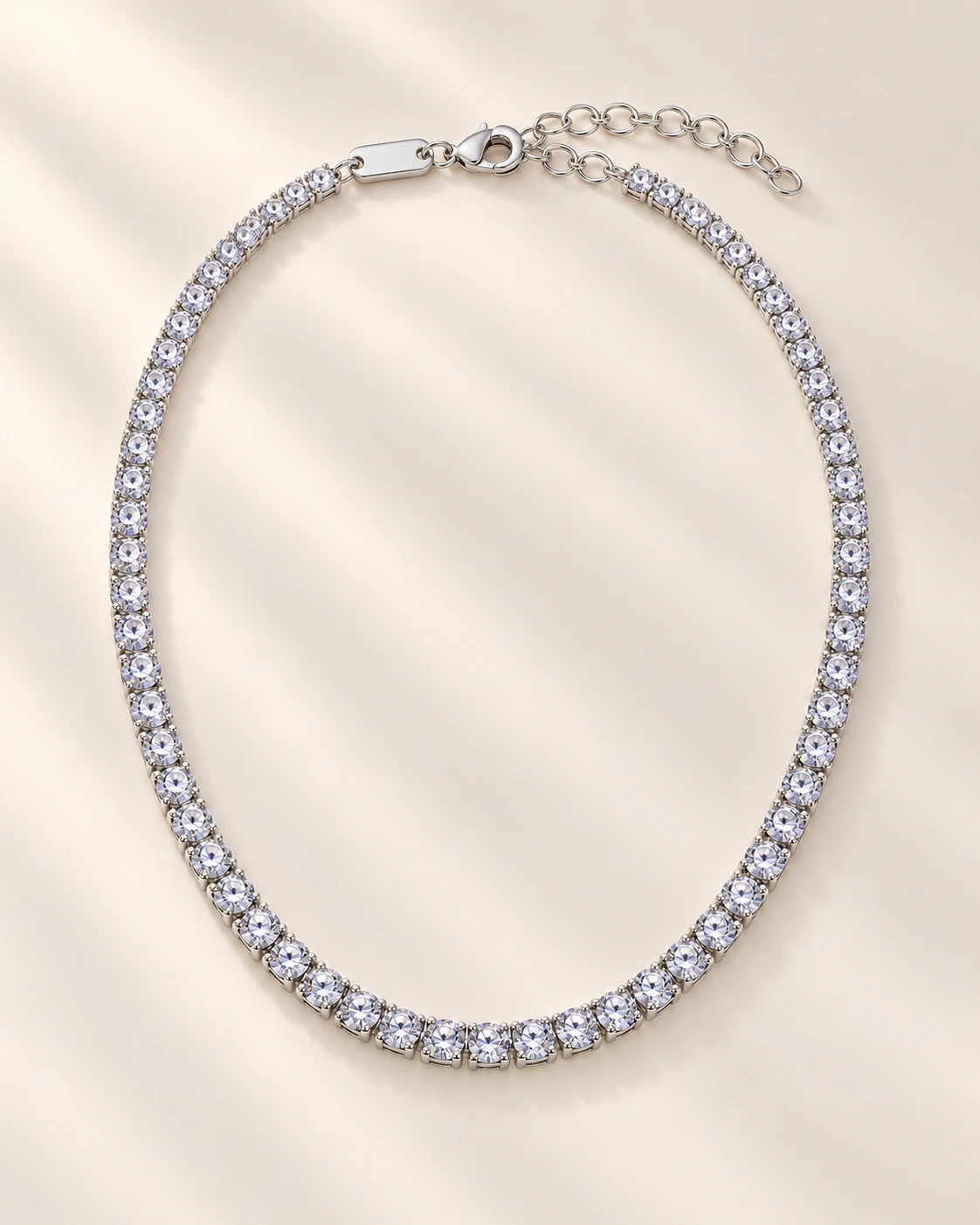
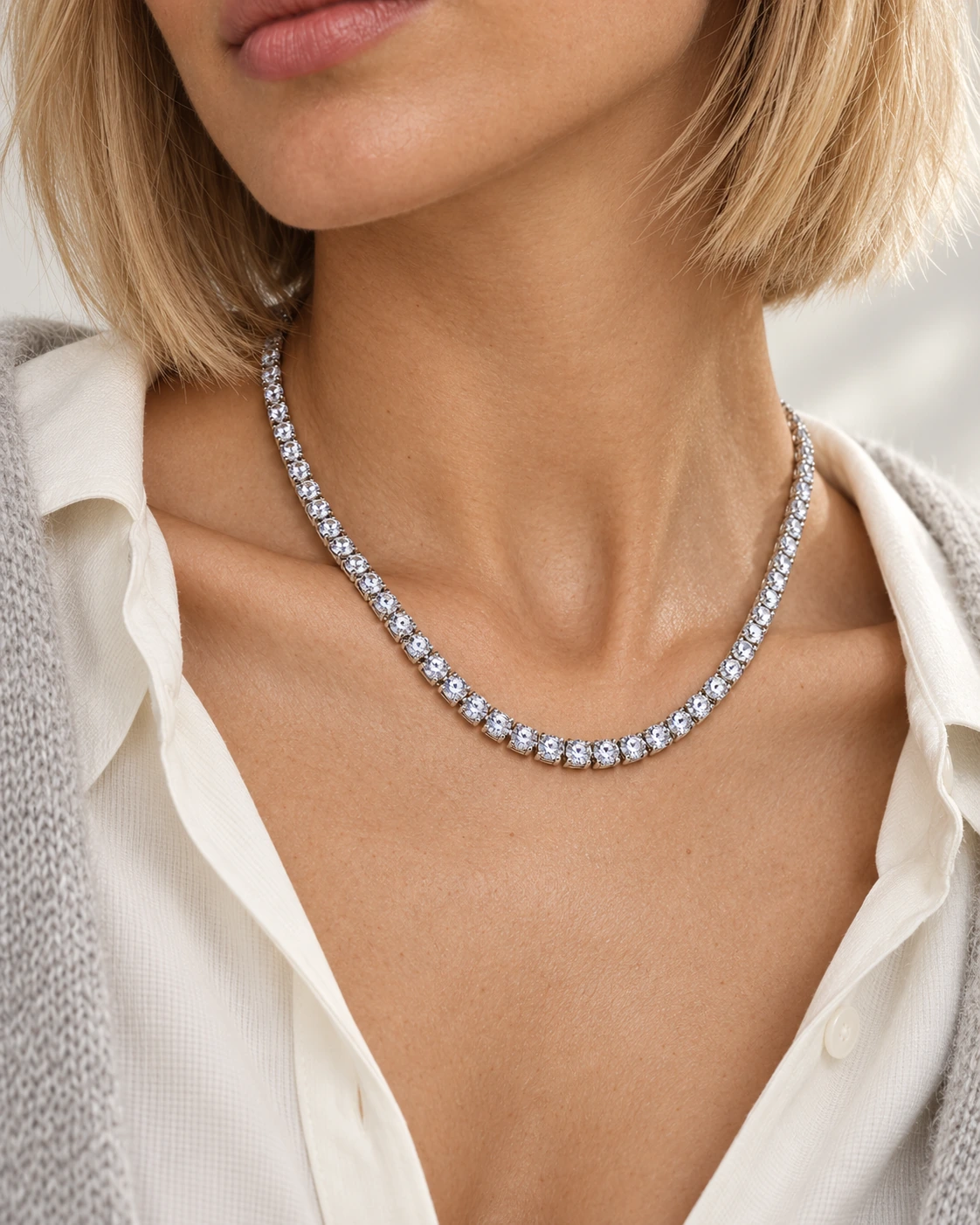
Rivière Fil has the same 42 + 3 cm measurement, but clear stones run across its front. There is no individual central pendant in this design. A listing marked “pendant only” presents a third situation: check your own chain or budget for a suitable one separately. A shared collection name, a matching colour and two pieces appearing together in a photograph are no substitute for a list of what is included.
Measure the bail and identify the end that has to fit
The bail is the part through which the chain runs. Lay the pendant on a soft, light surface. Look directly into the opening and then from the side. A bail may be oval, narrow towards the back, or sit behind the top of the pendant. You need the clear space inside it, at its narrowest point. The outside width of the metal loop and the height of the entire decorative fitting do not tell you what can pass through.
Open the clasp and put both ends side by side. One might carry a lobster clasp, the other a ring, a flat tag or an extender with a decorative tip. Decide which end you would thread through. Follow that section all the way to the first ordinary links. A slim end tag can pass while the next connecting ring stops at the entrance. Any extender on that end must pass in its entirety as well.
Record the clear width and height of the opening in millimetres, then the width and thickness of the largest fitting at the chosen end. Photograph each against a millimetre scale in the same plane. If the edge falls between marks, say so and ask the seller for a precise measurement. Equal nominal dimensions establish no clearance. Avoid pulling the chain, prising open a bail or flattening an end ring to find out whether the pieces will fit.
The chain fits through. Will the pendant sit straight?
For a removable pendant, compare two chains you already own. Untwist each one, hold it by both ends and lift it. Does the pendant settle in the centre freely? On a flat chain it can be particularly easy to see a link turned edge-on by the bail. On an articulated chain, watch for joints catching at the edges of the opening. Resistance is a reason to stop even if the very tip slipped through easily.
Fasten the chain and look at the pendant against a plain T-shirt. Turn your head, sit down, lean forward and straighten up. Does it move briefly and return face forward, or does it stay on its side every time? Repeat in a shirt. If it flips only when it touches the collar, try another length. If it tips over even when suspended clear of clothing, changing the neckline will not change the orientation of the bail.
Chain length and pendant drop are two different measurements
Open a familiar necklace, lay it on a table and measure from the clasp to the link you actually use. Then measure vertically from the point where the pendant rests on the chain down to its lowest edge. Ask for both figures separately when shopping online. Stone height can be less than the height of the pendant including its bail. The same length of chain puts the bottom of a short medallion and an elongated drop in different places.
Compare one pendant with one shirt. Fasten it at the usual link, then farther along the extender. Keep the camera at the same height. Can you see the bottom of the pendant between the edges of the shirt when buttoned as usual? A 3 cm extender adds to the circumference. It does not move the pendant exactly 3 cm down the body. For a closer comparison, see the necklace length guide.
Buying the pendant and chain separately
A gift for someone with a favourite chain. Ask for a photograph of the open ends against a scale. A picture of the chain being worn can help with style, but the collar usually hides precisely the ring that needs comparing with the bail. If you want to keep the gift a surprise and cannot obtain a measurement, decide whether using the old chain is essential. If it has sentimental importance, arranging a fitting together beats guessing from the width of a link. A complete necklace offers a ready-to-wear alternative.
Suppose a flat chain tag is 4 mm wide and a rigid circular bail has an inside diameter of 3 mm. The tag will not pass even if the links are only 1 mm wide. Check the other end. If its clasp is also too wide, look for a different chain. These illustrative measurements do not describe the Miréa models.
A pendant may carry the chain through a concealed channel behind the stone. In a front view the entrance can look generous, while the passage changes direction farther in. Ask to see both ends and the back. A long rigid fitting needs enough space to turn as well as pass the entrance. If the seller has both pieces, ask to see the chain threaded and removed in one continuous sequence. For an heirloom pendant with unfamiliar construction, take the piece to a fitting rather than dismantling anything at home.
Five questions before you order
Check the contents, removability, clear bail opening, end fitting and position against your neckline. Ask a specific question if a detail is missing: “My chain has a flat tag at the end. Could you measure the inside height and width of the bail and show it from the side?” If you want a complete necklace and plan to leave it intact, concentrate on what is included, the wearable length and the height of the centrepiece.