How to choose fashion jewellery with a fine jewellery aesthetic
See three Miréa designs close up and on a model. Compare how stones catch light, where the setting sits and what to ask before buying online.
Maison Miréa editorial team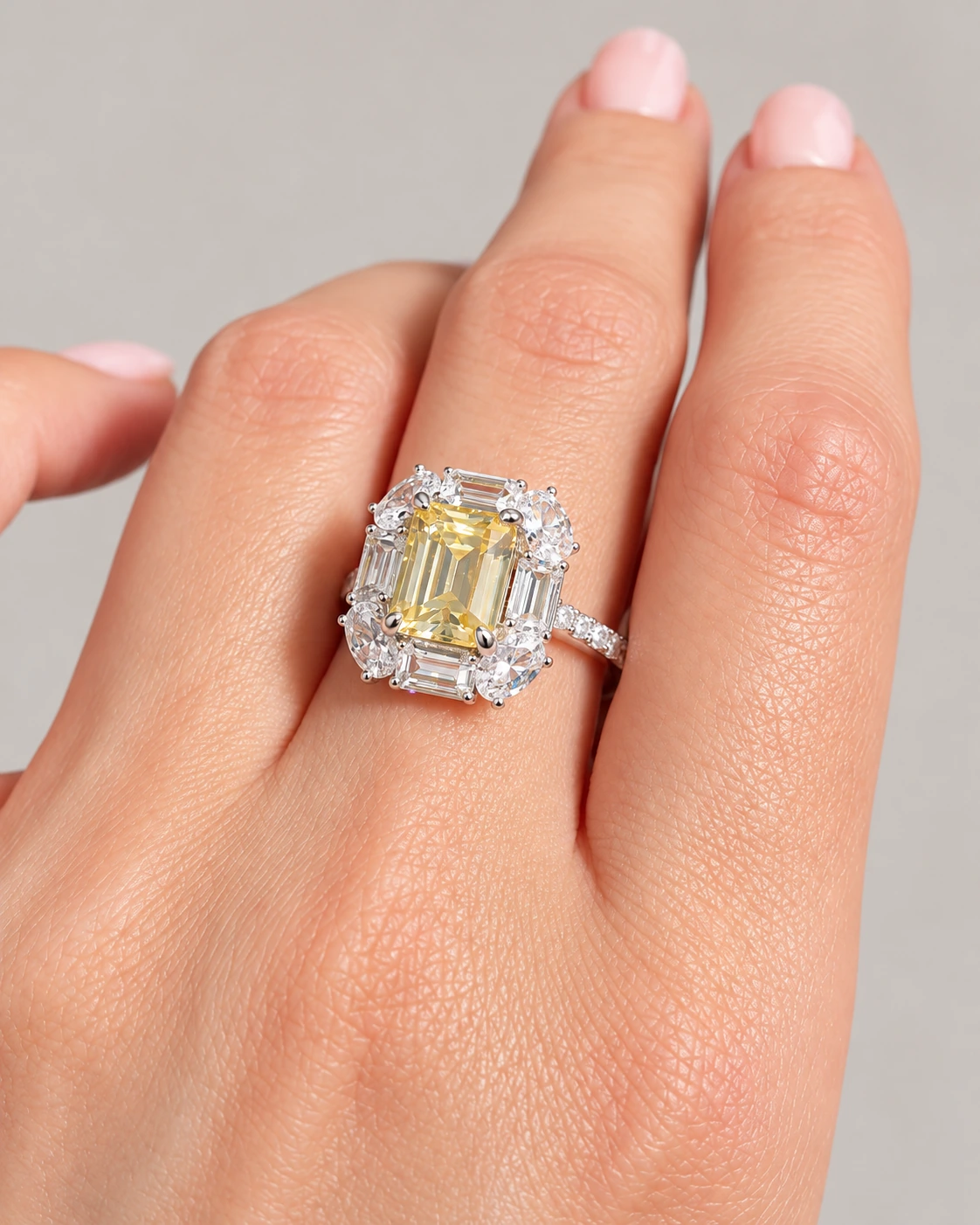
If you want fashion jewellery that looks like fine jewellery, start with two pictures of the same piece. In the close-up, look at how much of the design is stone and how much is setting. On a model, see which parts still read when a hand, shoulders or face enters the frame. A fine curve with one point of colour can make a clearer impression than several large stones side by side.
A fine jewellery aesthetic describes a visual effect here: the pattern, proportions and position on the body. Read the material description separately. All three Miréa examples have a brass base and cubic zirconia stones. A pale yellow centre, a clear halo or a bright reflection tells you neither the metal composition nor the origin of a stone.
Look past the brightest reflection
Trace the outside shape first. On a ring it is the outline of the whole head across the finger; on earrings, the line from the lobe to the lowest drop; on a necklace, the arc between the collarbones. Now find the brightest point in the picture. If that is where your eye goes first, move the screen away. What remains when you can no longer distinguish individual facets? A rectangle, a fine line and three points make different impressions even in the same colour family.
Avoid comparing two pieces on the strength of photographs with different backgrounds and lighting. A large white reflection shows the direction of the light and can obscure the pattern in a stone. A softer light may reveal that pattern again. For an online choice, the setting outline, the stone’s position and the scale on a person are more informative. A bright photograph cannot show that a stone is securely mounted.
Éclat Aurélie ring: how much room does the halo take?
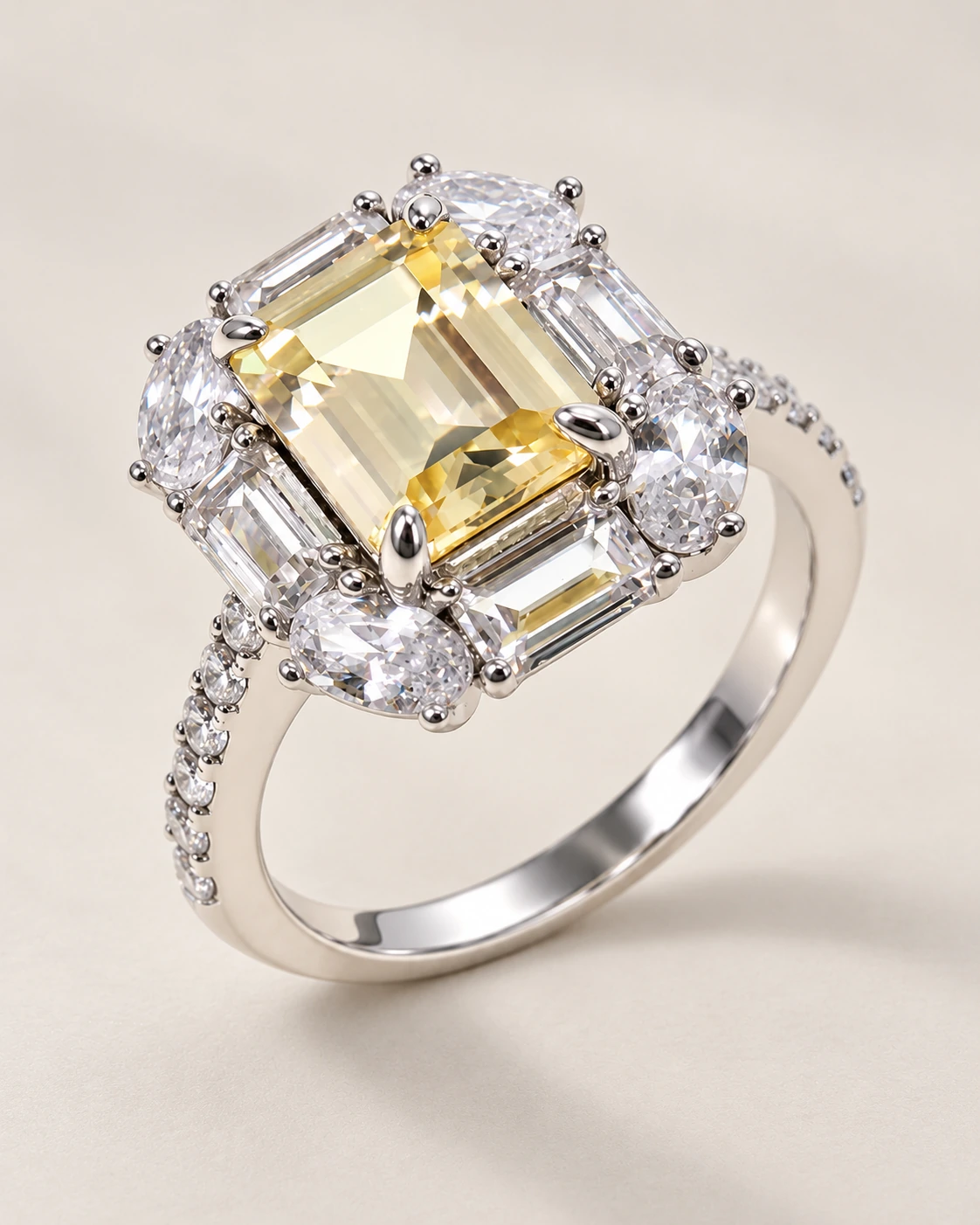
The pale yellow rectangular centre of Éclat Aurélie has clear round and elongated stones around it. Follow the short side of the rectangle to its outside edge in the product picture. The halo changes direction: the elongated elements continue the edges, and the round ones soften the corners. The result has a different outline from a single stone inside a rectangular frame. Light catches several parts of the halo while colour stays concentrated at the centre.
On the finger the first thing you notice is a broad patch of pale yellow. Compare the width of the head with the finger and the narrower band beneath it. This view helps if you want one distinct accent on your hand. For a quieter outfit, try it without neighbouring rings and against a plain sleeve. The halo will have room around it while the ring remains the focal point.
At a fitting, turn your hand sideways, pick up a pen and slip your hand into a sleeve you usually wear. The height of the setting matters here and is hard to judge from the front. When shopping online, ask for a profile with a ruler and the height from the band to the top. A photograph of another hand gives you a reference for proportion; you still need the correct size for your own finger.
Courbe Horizon necklace: space between the ends
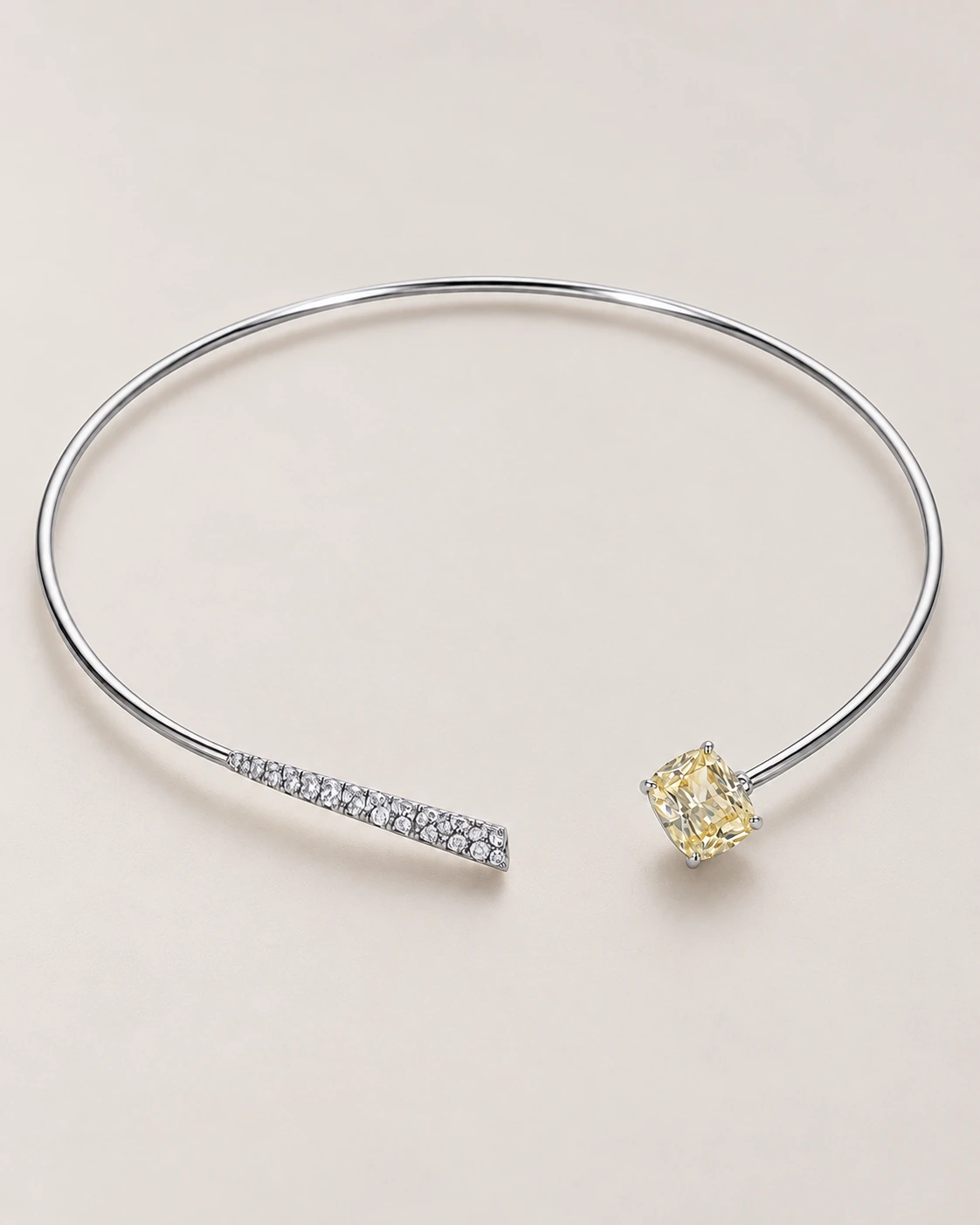
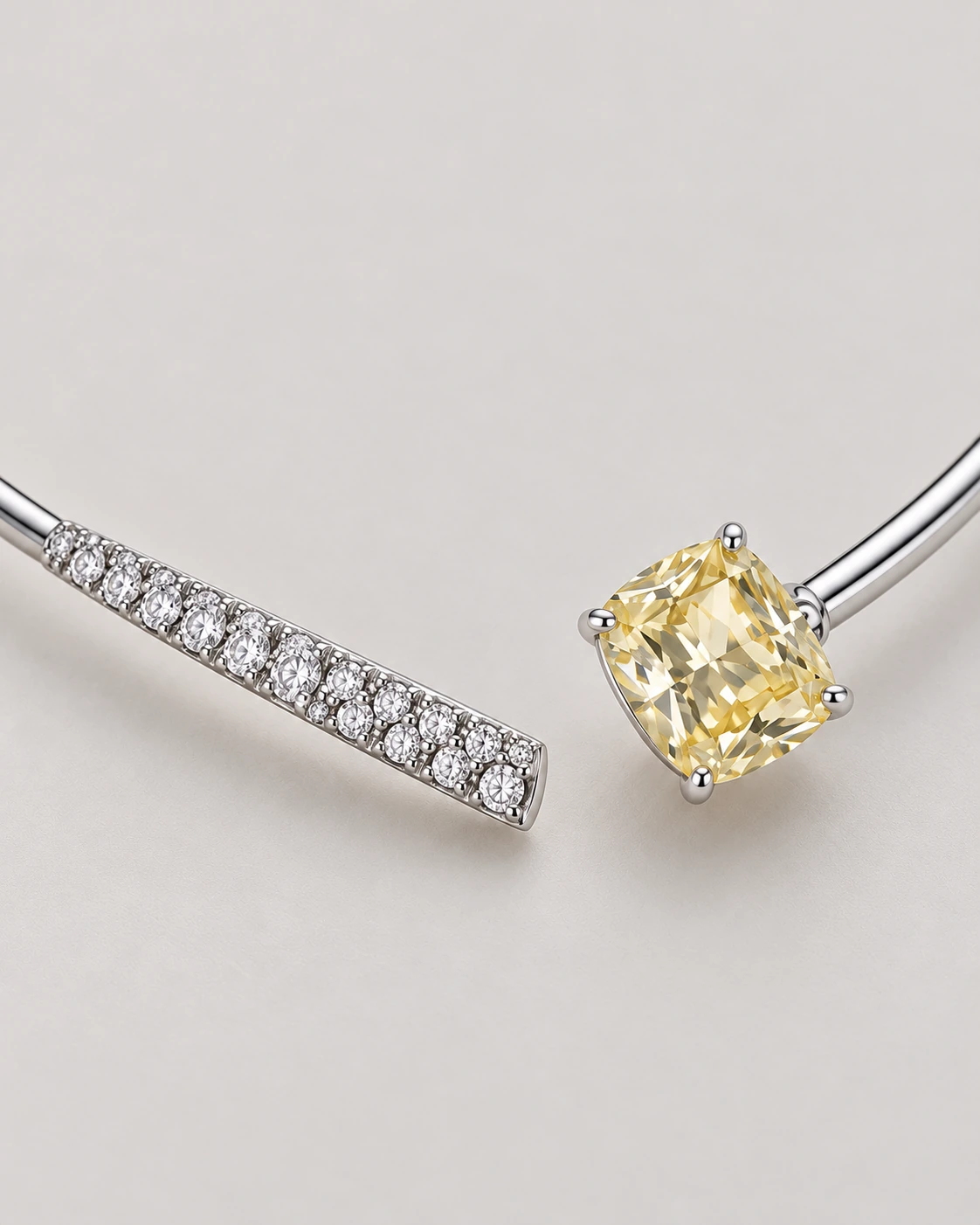
Courbe Horizon has a rigid, open outline. A yellow stone sits at one end and a short row of clear stones at the other. The detail photograph shows the row as a sequence of small highlights while colour gathers at a single point opposite. The space between the ends lets both elements read clearly.
On the model you see the entire arc. With an open neckline it makes a quiet line at the collarbones, with a small point of interest at either end. Start here if you want the most understated of these three looks. Try the necklace with one shirt button undone and then two. If the collar hides the row and leaves only the yellow stone visible, the asymmetry becomes less apparent.
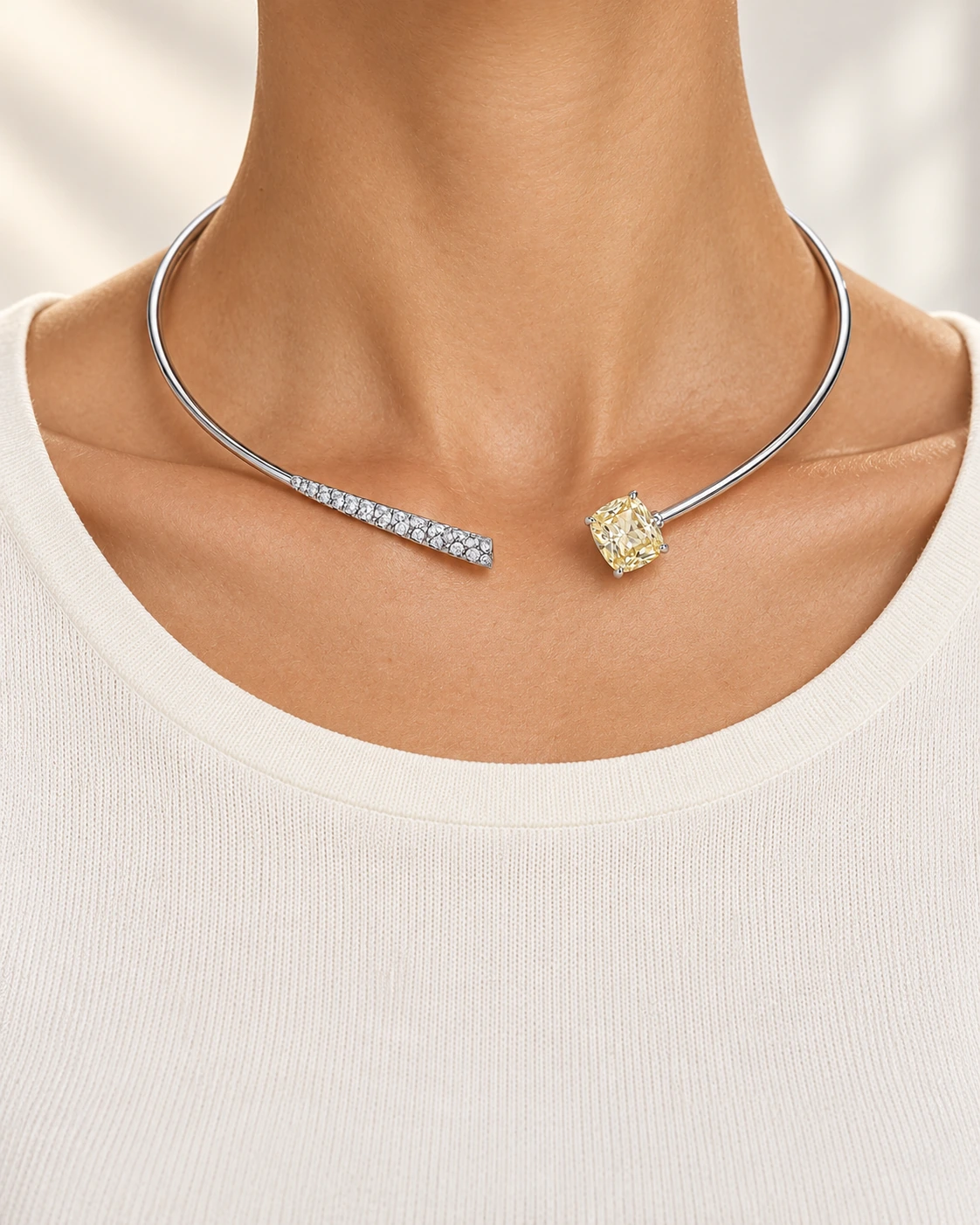
The listing gives a length of 38 cm. That number does not locate the ends on your neck: a rigid open shape sits differently from a loose cord of the same length. Sit down and turn your shoulders during a fitting, watching the ends against the collar. For an online purchase, ask for the inside width of the arc and a straight-on view. Check with the maker before trying to reshape the necklace.
Rivière Cœurs Dorés earrings: a pattern in motion
Rivière Cœurs Dorés has three pale yellow hearts in clear halos, joined by fine chains. The product image shows both the stones and the spaces between them. Those spaces let the eye pick out three repeats instead of one continuous patch of sparkle. On the model the individual links recede, leaving a vertical sequence of three light points beside the neck.
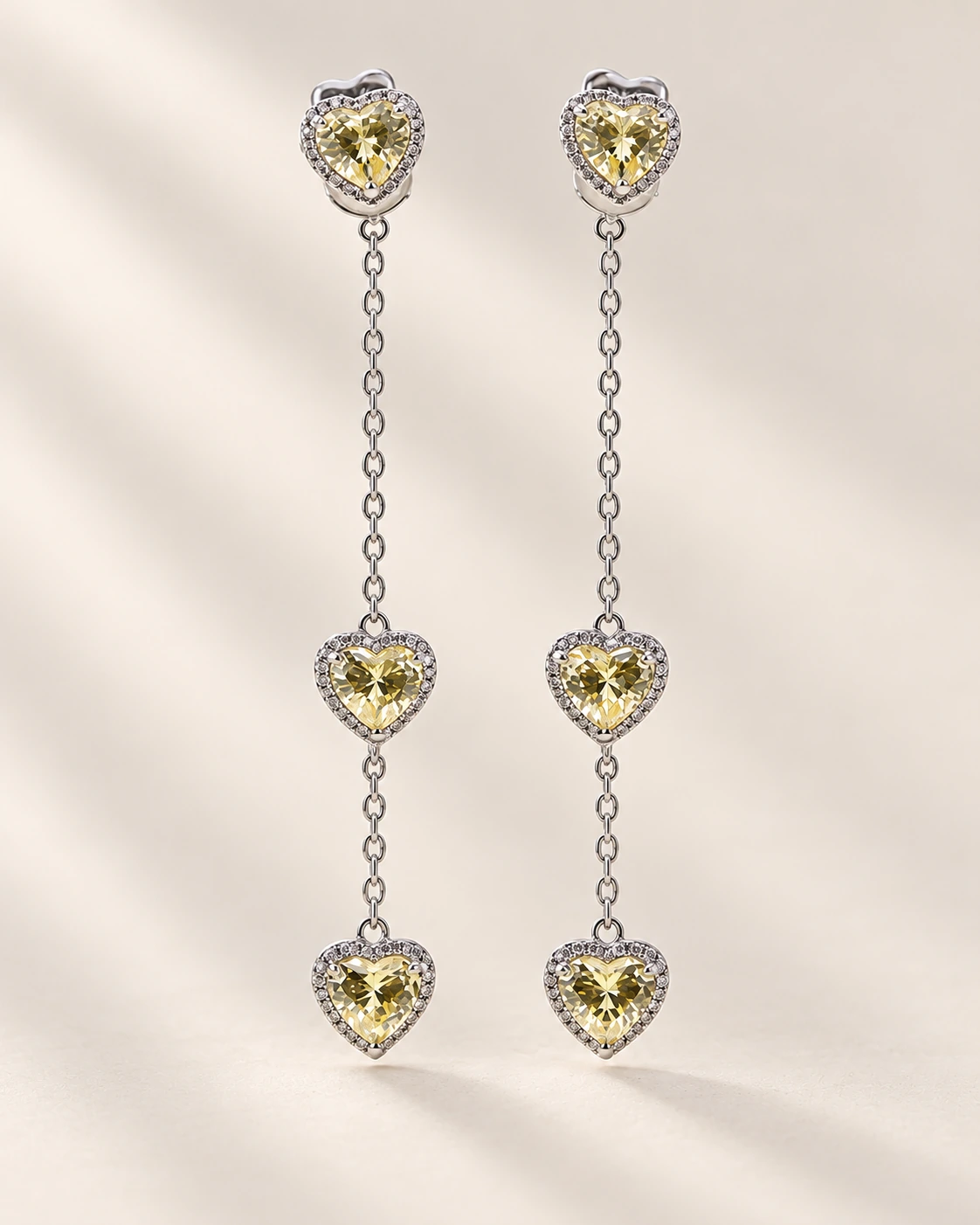
For a statement look, leave the vertical line visible. Compare hair tucked behind the ear with a single loose strand beside it. For a quieter result try a plain top without another long pendant. Add or remove the necklace separately to see what changed. The earring listing specifies rhodium plating and silver posts; the base is brass. The reference to silver applies to the posts.
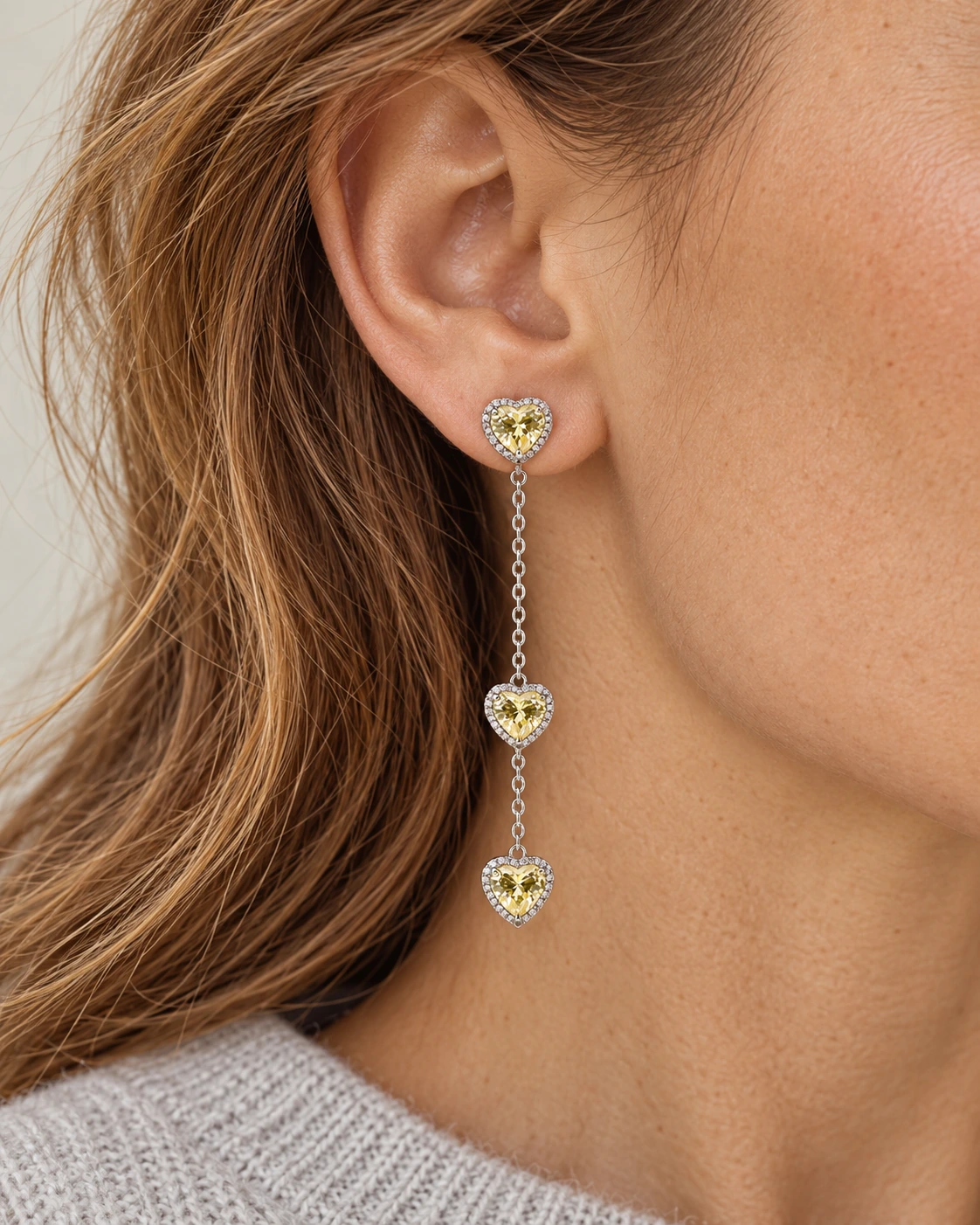
A profile photograph shows the drop on one model and cannot establish how far it swings. At a fitting, slowly look over your shoulder and return to centre. Watch whether the lowest heart touches your collar or a strand slips between the drops. If you cannot try the earrings on, ask for a short video at normal speed and the distance from piercing to lowest edge. For any weight comparison, check whether the figure covers one earring with its back or both earrings.
Compare a quiet and a statement look at home
Wear the same plain top beside the same window. Start with Courbe Horizon as the only noticeable line near your face. Then leave your clothes and camera position unchanged and replace it with the long earrings. Photograph each version from conversational distance. Which brings attention to the face first, and which makes the neckline stand out? Give the ring its own pair of pictures: a close-up and the way your hand looks holding a cup.
A checklist for buying from photographs
Check the reference in each picture. Ask for a front view and a profile in ordinary diffuse light without colour filters. For the ring, record the size and head height; for the open necklace, the length and inner width; for earrings, the length from piercing and the basis of the weight. Finally, choose the feature you want to see from across a table: an even line, a distinct coloured centre or movement. That gives you a better basis for choosing than counting bright details in an enlarged photograph.
A closer look